Free multiplayer space strategy · Plays in your browser

Conquer the solar system. One hour at a time.

Orbital is a persistent real-time strategy game for two to ten players, set across the real Sol system. Send fleets between moving worlds, build and terraform colonies, bend the Senate to your will, and come back to find out what your rivals did overnight.

See how it plays
  • 2–10 players
  • 1 hr a tick (one step of the game clock), or your pick
  • 3 ways to win
  • $0 no ads
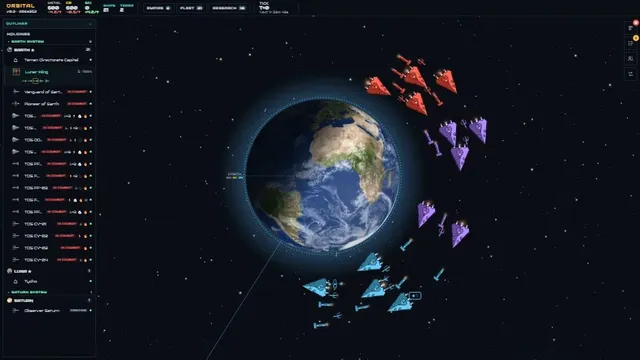
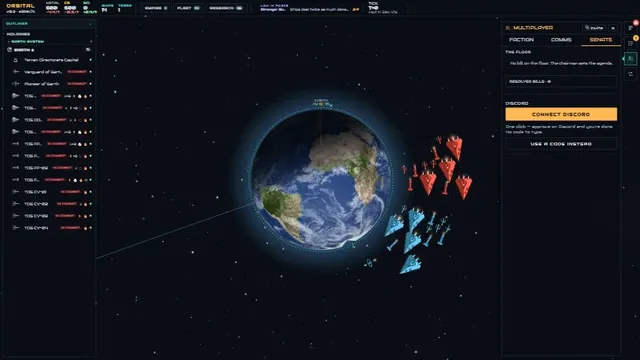
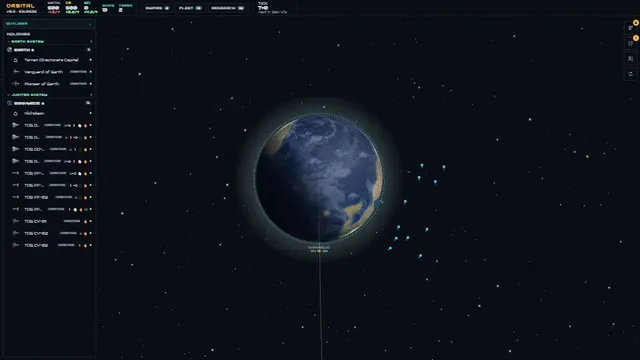
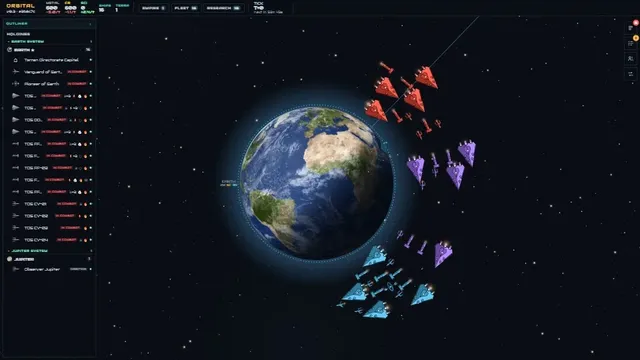
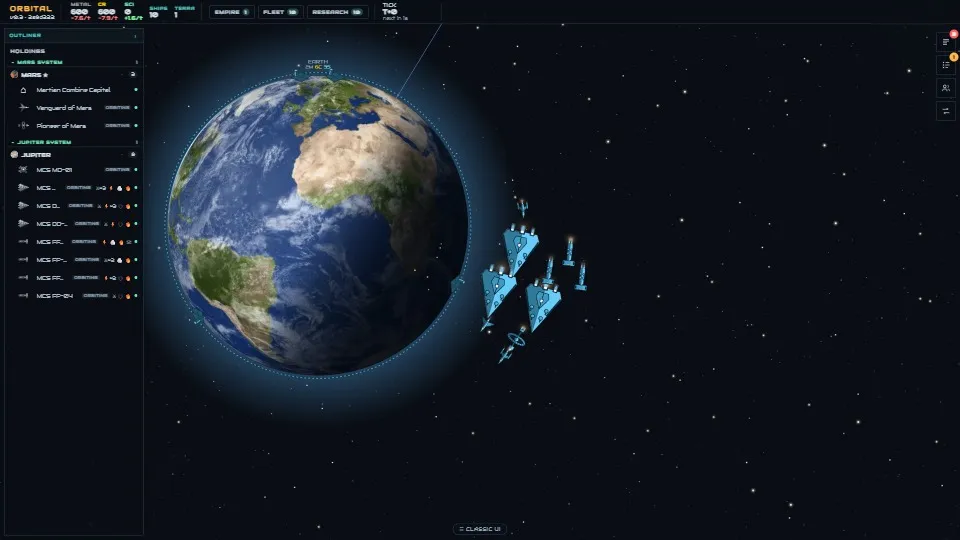
Earth’s blue fleet waits in orbit. At Jupiter a player boxes a Mega Destroyer and its red escort and sends them to Earth. A blue squadron from the asteroid belt intercepts them in flight and rides in beside them; in Earth’s orbit the Mega Destroyer’s beam scorches the planet, and Earth’s fleet destroys it.
Recorded in the game: a Mega Destroyer is sent from Jupiter, sets Earth burning and is destroyed by Earth’s fleet.

How it plays

The game keeps running when you log off

Ticks resolve on the server on a real schedule. You don’t need to be online when they do, only when it matters.

  1. Give your orders

    Send fleets, queue ships at your yards, propose laws, make offers. A few minutes is enough.

  2. The clock ticks

    Every tick, ships move, battles resolve and economies pay out — hourly by default, whether you’re watching or not.

  3. Read the briefing

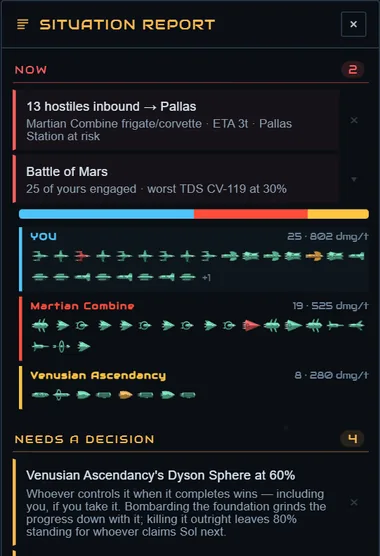
    The Situation Report shows what changed: fights in progress, fleets inbound, idle shipyards, decisions waiting on you.

The Situation Report panel: thirteen hostiles inbound to Pallas, the Battle of Mars in progress, and four decisions waiting.
The Situation Report, as a player saw it this morning.

Alerts reach you by browser notification, Discord or email.

The game

Everything an empire needs, and nothing it can take for granted

The real solar system is the map

From the Sun out past Pluto, every world sits where it really is and moves along its orbit. Distances change as the planets turn, so choosing when to launch is part of the plan, and a long flight is a commitment your rivals can see coming.

  • Planets, moons, the asteroid belt, the Kuiper Belt and the Far Reach beyond it
  • Even the Sun can be claimed
  • Hidden discoveries: derelict warships, ancient databanks, lost gates
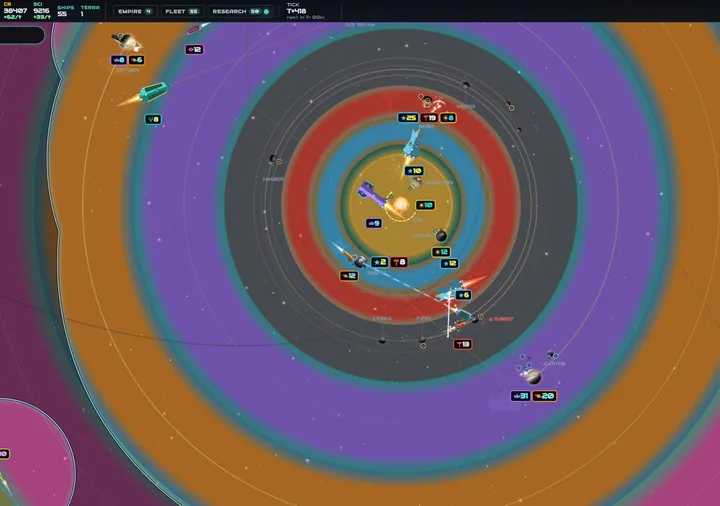
The whole solar system zoomed out, ringed by each empire's territory, with fleets and outposts across it.
Eight empires across the inner system, the belt and the gas giants.

Design the fleet. Choose the fight.

Build corvettes, frigates and destroyers to your own designs. Railguns or energy lances, armour or shields, flak, repair bays: shields blunt kinetic fire and armour blunts energy, so the right loadout depends on who you’re fighting. Fleets clash in orbit, and can be caught and fought in mid-flight.

  • Captains who rank up with every kill
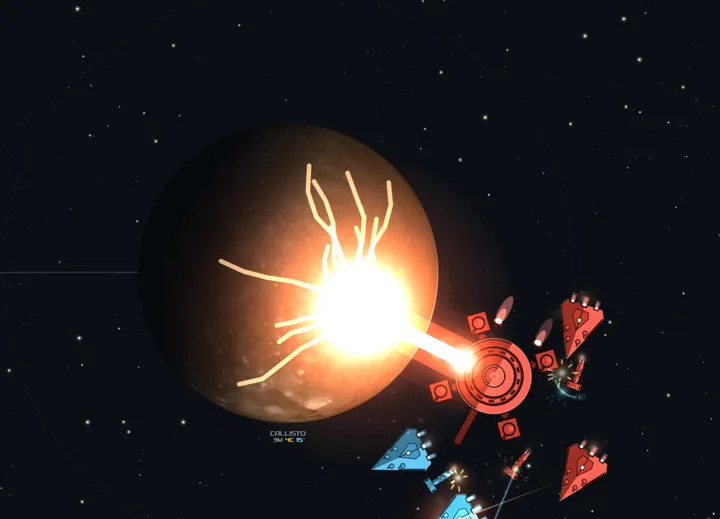
  • Megastructures: Warp Gates, Weapons Stations, the planet-wrecking Mega Destroyer
  • Battles can be replayed afterwards as recaps
A red Mega Destroyer fires a beam into Callisto while its escort trades fire with a blue fleet in orbit.
A Mega Destroyer and its escort fight over Callisto, and the beam lands.

Build, terraform, expand

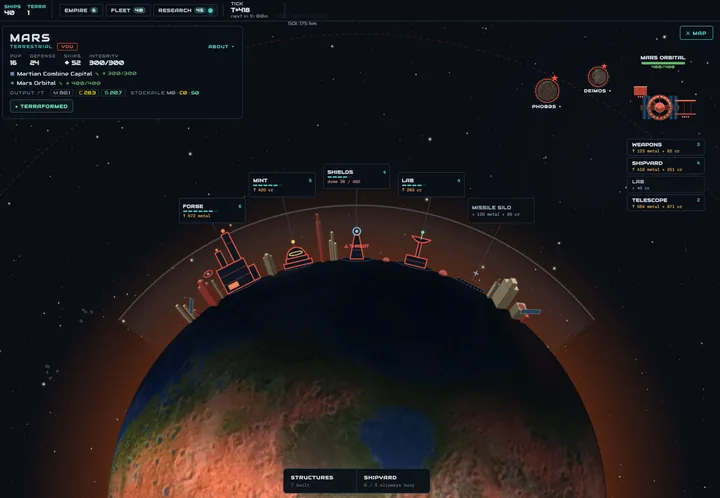
Plant stations in orbit and cities on the ground. Terraform raw worlds into living ones, raise forges, mints, labs and shipyards, and run freighters to haul what you mine back home. Every shipment is physical, and every shipment can be raided.

  • Six research tracks, from weapons to sensors
  • Trade with rivals on an open market
  • Mine drifting meteoroids for metal and credits
The Mars world menu: the city’s buildings stand on the planet’s rim (forge, mint, shields, lab and a missile silo), each with its level and upgrade cost.
A terraformed Mars: the capital, its buildings and the shipyard queue.

Politics with teeth

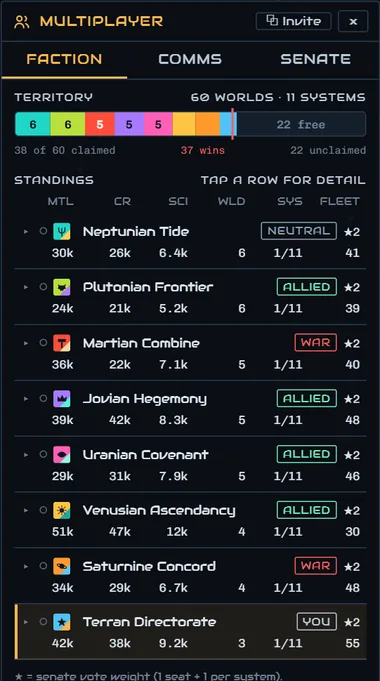
Every game starts at peace. War is declared, not assumed, and ending one takes both sides. Sign pacts, trade and share intelligence, then take it to the Senate, where passed laws change yields, costs and damage for everyone, and sanctions land on whoever you name.

  • Your vote weight grows with the systems you control
  • The Sensors track decides how much you know about your rivals
  • Alliances are made by players, not scripts
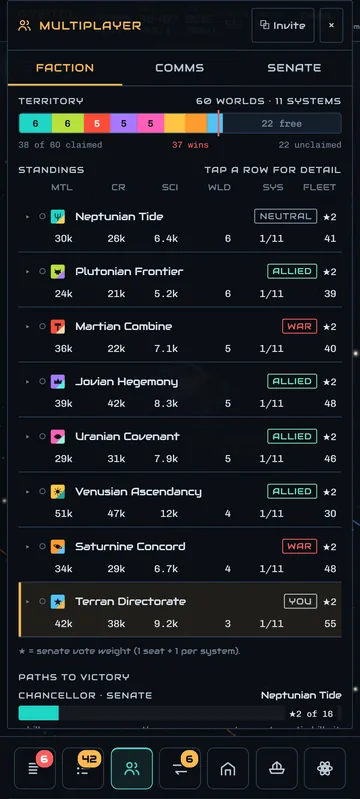
The empire standings panel: eight factions, their resources and fleets, marked allied, neutral or at war.
Standings, alliances and wars in a live game.

Victory

Three ways to win. Every rival can stop you.

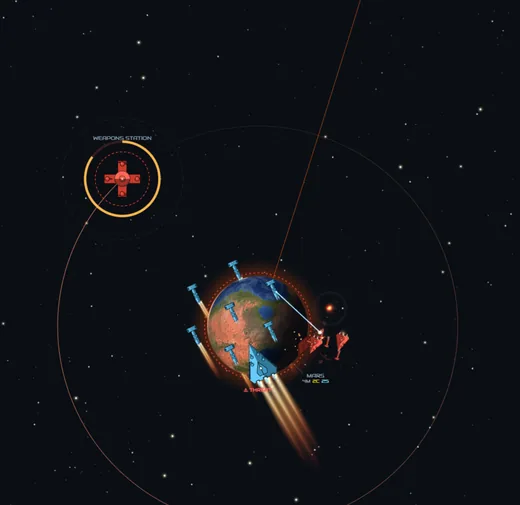
A blue raid burns in on Mars past a Martian Weapons Station.

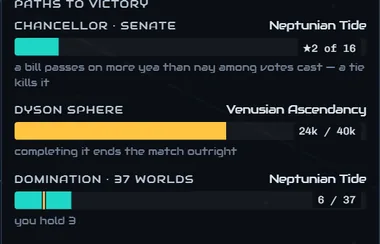
Domination

Hold more than 60% of the worlds in play (the host can change the bar). The Sun counts.

The paths-to-victory tracker: the chancellor vote, the Dyson Sphere and domination.

Supreme Chancellor

Win the Senate’s vote. Each empire gets one bid per game, and the vote stays open for 48 ticks, long enough for rivals to rally against you.

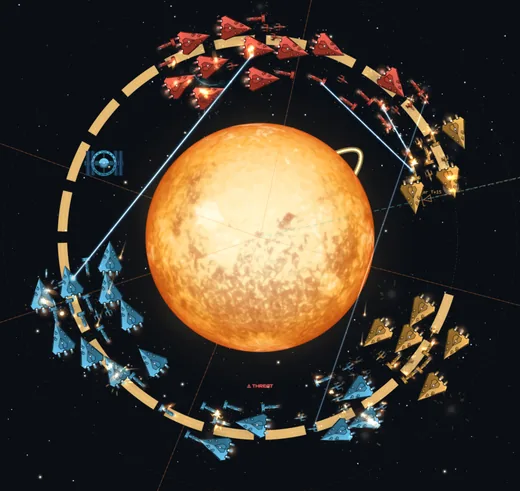
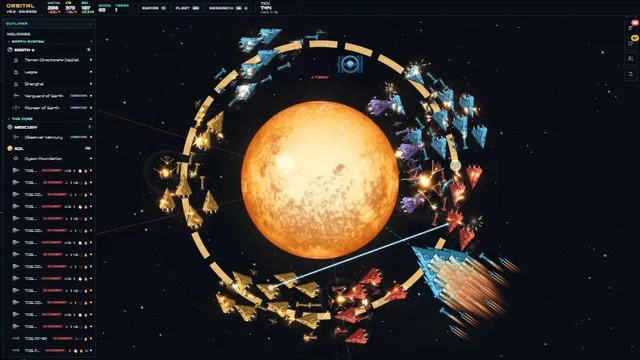
Four fleets fight around the Sun, inside the ring of a Dyson Sphere under construction.

The Dyson Sphere

Found a station in orbit of the Sun and feed it 15,000 metal, 15,000 credits and 10,000 science. Rivals can destroy the foundation, and whoever rebuilds it keeps most of the progress.

Recorded in the game

Scenes from the war for Sol

Blue, red, gold and purple fleets circle the Sun inside the Dyson Sphere’s ring, trading fire.
Four empires fight for the Dyson Sphere, in orbit around the Sun itself.
A Mega Destroyer fires a beam into a living world; the surface burns, then turns grey and cratered.
A Mega Destroyer’s first strike: every city on a living world burns to ash.
Red, purple and blue fleets fight over Earth, then the camera crosses the system to a battle over Titan.
A three-way battle for Earth, while another war burns at Titan.
The Senate panel shows the passed bill, then red and blue fleets fight over Earth.
The Senate authorises war: every hit on the target now does double damage.
Blue ships near Earth are selected and sent across the system, where they arrive and fight a red fleet.
Select your ships, pick a target, and they fly a real orbit to get there.
After a battle over Earth, the camera follows the war across the solar system to a battle over Europa.
Win the battle for Earth, then take the war to Jupiter.

Anywhere

Your empire fits in your pocket

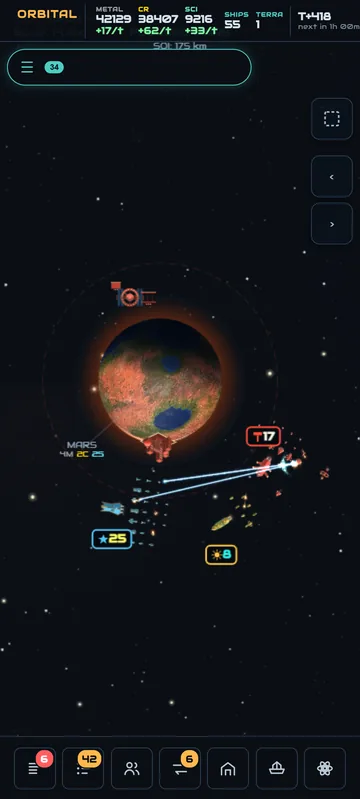
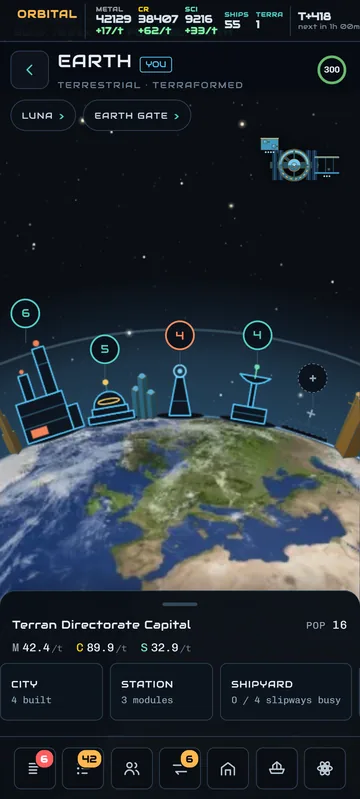
Orbital runs in any modern browser on desktop, tablet and phone, with a layout built for touch. There is nothing to install. Android and Wear OS apps, with home-screen widgets, are in testing.

The battle over Mars on a phone.
Earth’s world menu on a phone.
The empire standings on a phone.

Questions

Before you take command

Is Orbital free?

Yes. Orbital is free to play with no ads, and nothing that affects the game is for sale. An optional one-time Commander’s Commission ($10) unlocks ship designs, megastructure looks, premium emblems, and your games posted to your own Discord server.

Do I need to download anything?

No. Orbital runs in any modern browser on desktop, tablet or phone. Sign in with Google or an email address and join a game straight away.

How long does a game last?

There is no time limit: a game runs until someone wins. The default is one tick an hour, which suits checking in a few times a day. Hosts can choose anything from a tick a minute to a tick a day.

What happens while I’m offline?

Your empire keeps going. Ticks resolve on schedule, freighters keep running their routes and armed stations defend themselves. Nobody plays your empire for you, so set your orders before you log off.

How many players are in a game?

Two to ten. Quick Join drops you into the fullest open game, or you can browse the lobby or invite friends to a private game. You can even join a game that has already started, as long as a home world is still free.

Is Orbital like Neptune’s Pride?

If you have played Neptune’s Pride, the rhythm will feel familiar: a shared map, ticks that run on a real clock, and alliances that matter. Orbital sets it in the real solar system and adds orbital flight, ship design, a Senate that writes the rules, and three different ways to win.

Your seat in the system is waiting

Join an open game in one click, or start a private one for your group.

Free · No download · No ads